

What are the active and passive methods of fire prevention and exactly how important are they?
Firstly, let’s discuss the main causes of fire to better help prevent them in the future.
Why do fires start?
In more recent years business owners and premise owners alike have become a lot more cautious over fire safety. This is understandably so after tragedies such as Grenfell Tower.
The easiest way to ensure a building is safe is by stopping a fire breaking out in the first place. In order to be well equipped to prevent fires, first we must understand the most common ways fires break out. These include:
- Kitchen appliances – fires can break out from appliances that have not been switched off properly.
- Cigarettes – although this seems obvious, even in today’s society smoking is one of the leading causes of fires.
- Faulty smoke alarms – if your smoke alarm is not regularly tested, this plays a risk in enabling a fire to spread.
- Overuse of power cords and extension leads – if too many appliances are plugged into the same outlet.
- Computer equipment – if cooling vents on laptops or computers become blocked, then the appliance can overheat. This fire hazard can largely be prevented by only using such equipment on a hard surface.
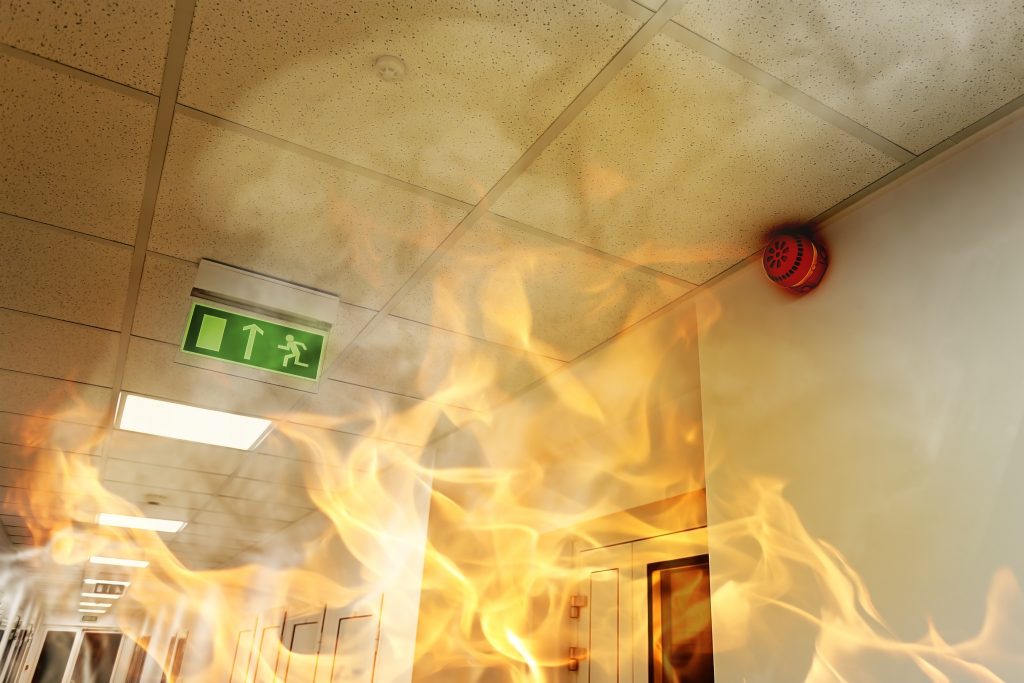
Fires prevention methods
The fact that many fires can be prevented or at least contained is something that businesses should act upon. There are several ways to prevent fires from spreading. These are often categorised by active and passive methods. Active fire prevention is using techniques or equipment which is manually operated such as a fire extinguisher. Passive fire prevents methods that are in place regardless of human intervention or not, such as the structure of a building.
There are many other examples of passive fire prevention that, are effective for as long as the building stands. These include:
- Fire compartmentation – by changing a building’s materials and adding protection to walls, doors and windows, the spread of fire can be dramatically slowed down or even stopped simply by design alone.
- Fire doors – similar to fire compartmentation, if fire doors are built from the correct material they can act as a barrier to fire and slow down its spread.
- Cavity barriers – these prevent the spread of fire by blocking the path of fumes and flames alike.
- Fire and smoke curtains – vertical loft space and roof voids often pose fire hazards, however if fire and smoke curtains are used, these limit smoke fumes building up in such areas.
How can Artius Fire Protection help fire prevention?
Artius Fire Protection has a range of services to help protect your business from fire. We aim to help complete risk assessments and alert you to the best methods of fire prevention for your premises in order to keep you safe as well as comply with legal requirements. If you would like to discuss these needs further, feel free to reach out.


